
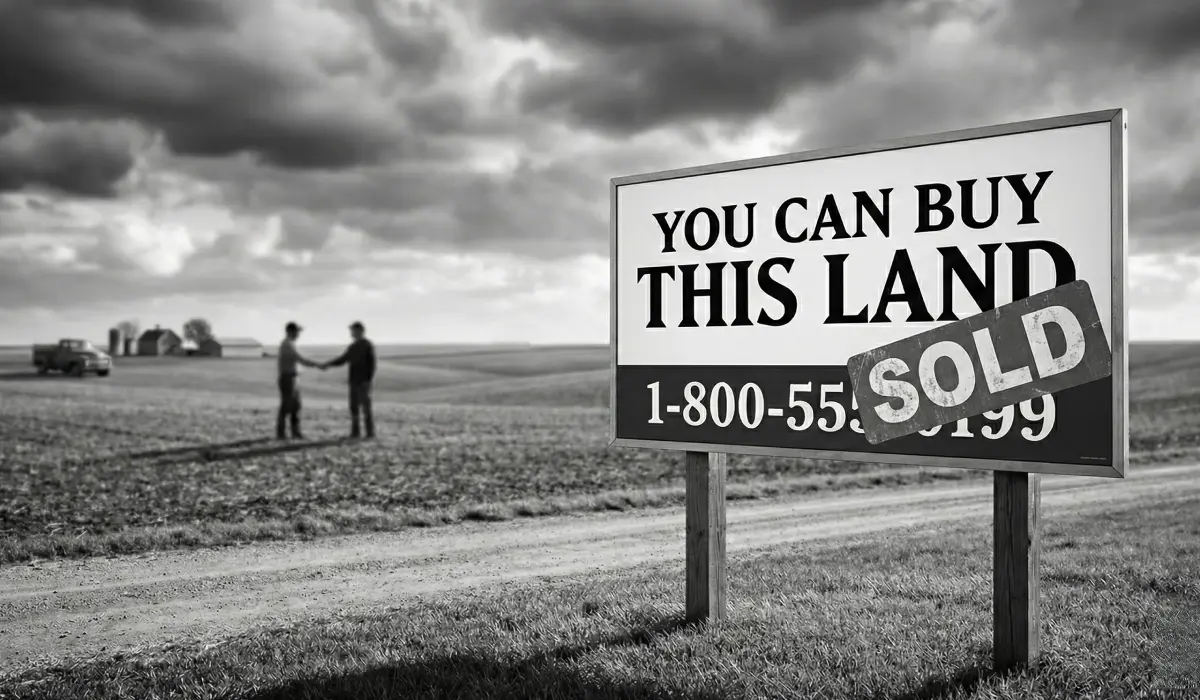
History tells a consistent story. Capital eventually migrates back to the foundation of the global economy: land. Since the first civilizations emerged, land has been the ultimate asset of wealth and power. In times of high volatility, rampant inflation, and disconnected public market valuations, the question among sophisticated investors isn't "if" they should allocate to real assets, but "how."
Is investing in land a good idea today? The short answer is yes. Land is finite, demand for its output is infinite, and it has historically served as an unparalleled hedge against currency debasement.
However, the nuanced answer — the one that separates successful institutional players from frustrated private buyers — is that how you invest in land matters far more than simply acquiring the deed to a pasture.
The landscape of U.S. land investing is shifting rapidly. What used to be a simple play on appreciation is now a complex operation requiring deep expertise in agronomy, logistics, and emerging environmental markets. For the private investor, direct ownership is fraught with hidden complexities that often turn a promising asset into a managerial liability.
There is a significant difference between buying raw land and hoping for appreciation, and investing in productive land restoration systems designed for cash flow.

Current trends in U.S. land investing
The appetite for land investing has grown sharply over the last decade. We are seeing a distinct migration of capital away from overleveraged urban commercial real estate and into rural and agricultural assets. This is driven by fundamentals.
The global population continues to expand, requiring more food, fiber, and timber. Simultaneously, the amount of arable land per capita is decreasing due to degradation and development pressure. This basic supply-and-demand imbalance has established a strong floor for farmland values.
 A family-owned farmland in the USA, rich in natural food resources. AI generated picture.
Current trends in U.S. land investing show incredible resilience. According to USDA data and various private indices, U.S. farm real estate values have seen consistent year-over-year growth, often outperforming the S&P 500 on a risk-adjusted basis over long horizons.
We are seeing several distinct land-type plays dominate the market:
-
Existing high-yield farmland: Buying prime, operational Midwest row crop operations. This is a low-risk, low-yield play increasingly dominated by massive institutional funds and REITs, driving cap rates down.
-
Transitional land: Purchasing rural land on the outskirts of growing metropolitan areas, purely as a speculative play on future residential or commercial zoning.
-
Degraded asset revitalization: Identify undervalued, underutilized land and deploying capital to restore its productivity. This is where the most significant potential for upside currently resides, though it requires the highest level of operational expertise.
The capital is moving. But where it is moving most effectively is not merely into holding dirt, but into making dirt productive.
Discover more: Real estate vs. nature investment: why nature holds the edge
Investing in land pros and cons
Before deploying capital, an objective and rigorous analysis of investing in land pros and cons is required. While the macroeconomic arguments for land are undeniable, the practical realities of direct individual ownership are often glossed over by enthusiastic brokers.
The advantages of investing in raw land
The primary draw of land is its tangibility. It is a real asset that cannot be printed away by central banks or wiped out by a flash crash in high-frequency trading algorithms.
-
Scarcity and inevitability: As Mark Twain famously quipped, they aren't making any more of it. The supply is fixed, yet the demands placed upon it for food, energy, and housing are exponential.
-
Inflation hedge: Historically, agricultural land values and commodity prices have tracked closely with, or exceeded, inflation rates. It protects purchasing power.
-
Uncorrelated returns: Land values generally do not move in lockstep with the equities or bond markets. This provides essential portfolio diversification during systemic shocks.
Discover more: How do you beat inflation in investing?
The significant disadvantages of direct ownership
If land is such a strong asset class, why doesn't every high-net-worth portfolio own thousands of acres? Because making land profitable is exceptionally difficult for non-operators.
-
Extreme illiquidity: Land is not a stock. You cannot click a button to exit your position. Selling rural land can take months or years, depending on market cycles and credit availability for buyers.
-
Negative cash flow (the carry cost): Raw land doesn't just sit there; it eats capital. Property taxes, insurance, and basic maintenance (fencing, security, clearing brush to prevent fire hazards) create a constant negative drag on returns unless the land is generating significant income.
-
Operational complexity: How to make money investing in land requires specialization. If you lease it to a farmer, you need to understand agricultural yields and fair market rents to avoid being underpaid. If you attempt to farm it yourself, you are entering a capital-intensive, low-margin business with massive weather risks.
-
Regulatory hurdles: Navigating water rights, zoning issues, endangered species regulations, and environmental usage restrictions can paralyze a project and drain resources through legal fees.
For the individual investor, buying raw land often means acquiring a second job you didn't want and expertise you don't have to manage an asset that is agonizingly illiquid.
Discover more: Top commodities to invest in today
What to consider before investing in land
If you are still considering a direct purchase, you must move beyond the price per acre and evaluate the operational reality.
Is the land worthy of investing in? That depends entirely on your ability to unlock its potential. A thousand acres of degraded soil in a drought-prone region is not an asset; it is a liability.
You must consider soil health and water availability above all else. Without secure, senior water rights, agricultural land value can evaporate overnight. Furthermore, what is the logistical infrastructure? Proximity to processing facilities, rail lines, and ports dictates the economic viability of anything you grow on that land.
Most critically, you must consider the talent gap. Modern, profitable agriculture — especially sectors like agroforestry or high-value permanent crops — requires PhD-level agronomy support and seasoned operational management. Do you have access to teams who understand regenerative farming practices at scale?
 American farmer examining soil, with modern machinery and farmland in the background. AI generated picture.
If you cannot answer these questions with certainty, direct ownership is likely a path to frustration rather than preservation of capital. The opportunity cost of managing land poorly is immense.
Discover more: Is sustainable investing profitable?
A new era: investing in land restoration
The difficulties inherent in direct land ownership have created a vacuum in the market. Sophisticated capital recognizes the value of the asset class but fails to account for the operational burden of buying raw land solo.
This has ushered in a new era: investing in land restoration through institutional-grade vehicles.
This approach moves beyond passive holding and into active value creation. It is the difference between buying a dilapidated house and letting it sit, versus buying it, renovating it with modern efficiencies, and renting it out at top-of-market rates.
We are seeing a pivot toward regenerative agriculture and agroforestry. This is not merely an environmental preference; it’s an in-demand, superior economic model for the long term.
Discover more: Benefits of investing in regenerative agriculture
Conventional farming often depletes soil, requiring ever-increasing chemical inputs that squeeze margins. Regenerative practices restore soil health, increasing yields over time while lowering input costs.
Furthermore, restored land performs a double duty: producing high-value food crops while simultaneously sequestering carbon into the soil and biomass. This opens the door to the emerging environmental commodities market, the next frontier of land investing.

Benefits of investing in land restoration
When you shift focus from "buying land" to "investing in a land restoration fund," the risk/reward profile changes dramatically. You retain the asset-backing of the land, but you outsource the complexity that makes direct ownership so challenging.
This is where the first-mover advantage is currently defined.
Discover more: Why is it important to start investing early?
1. Access to scaled expertise
By pooling capital in a fund structure, investors gain access to seasoned teams of agronomists, operators, and logistics experts that an individual investor could never assemble. These teams understand how to execute complex projects like converting degraded pasture into productive agroforestry systems producing coffee, cacao, or macadamia nuts.
Discover more: 5 Reasons why environmental commodities are the future
2. Dual revenue streams
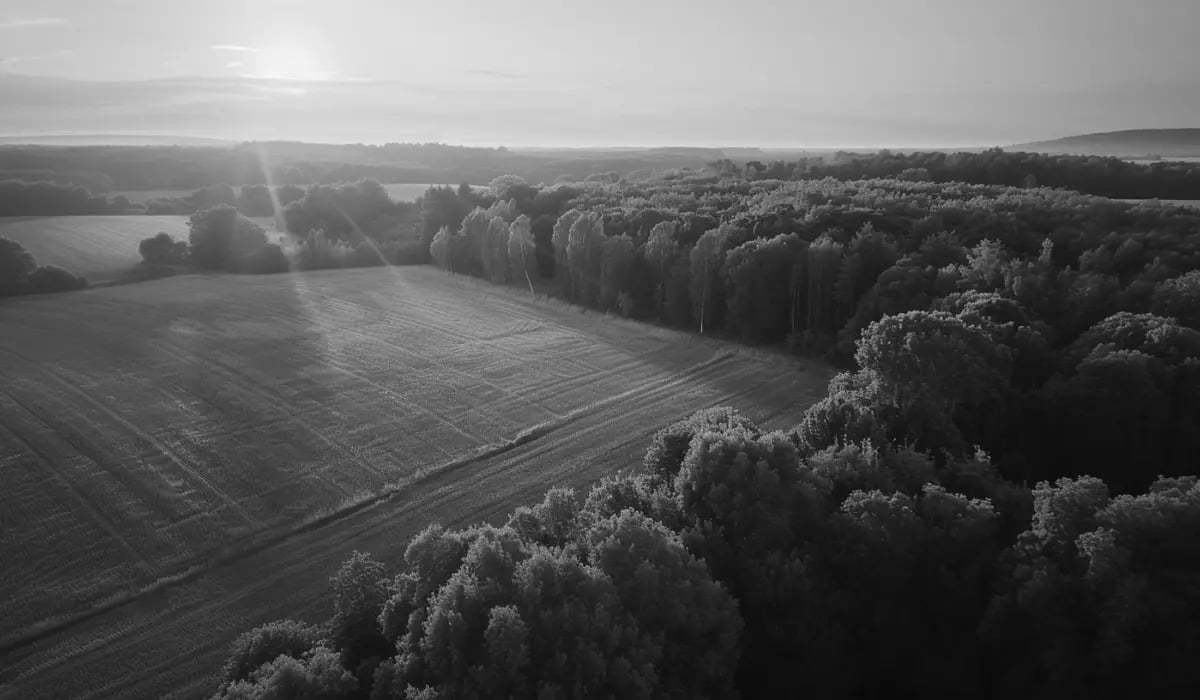 Aerial view of productive farmland beside a forest, showcasing regenerative agriculture. AI generated picture.
A sophisticated land restoration strategy does not rely on a single income source. It builds productive farmland producing high-demand crops for global markets.
Simultaneously, because these regenerative practices actively heal the soil and plant trees, the projects generate verifiable environmental commodities, specifically CO₂ capture. These are not hypothetical "credits," but measured, verified tonnage of carbon captured, for which there is significant demand from global corporations seeking to meet net-zero commitments.
This creates a robust financial model: income from food production, plus income from environmental integrity.
Discover more: What companies buy carbon credits?
3. Mitigation of operational risk
A fund structure provides diversification across different geographies, crop types, and climates, mitigating the weather and pest risks that can wipe out a single-farm owner. Furthermore, the fund handles the regulatory hurdles, the water rights, and the labor management. The investor receives the benefit of the asset’s performance without the headache of its daily operation.
4. Structured returns
Unlike buying raw land and hoping for a distant future sale, a well-structured land restoration fund focuses on generating cash flow. The goal is to provide payment-at-delivery structures, offering investors fixed income potential along with long-term capital appreciation as the underlying asset — the restored, productive land — increases in value.

First Mover Fund as the perfect solution
At the First Mover Fund, we recognized early that while the demand for real assets was growing, the options for private investors were limited. Buying raw land is too operationally burdensome, and buying into massive, existing farmland REITs offers minimal yields in overcrowded markets.
We positioned the First Mover Fund in the profitable middle ground. We identify undervalued, degraded land and apply the capital and expertise necessary to restore it.
We don't chase trends in established markets. We define the market by entering overlooked regions and utilizing proven regenerative methods to unlock immense value. We transform dormant assets into productive powerhouses yielding food and verified CO₂ capture assets.
For the qualified investor seeking the stability of land without the operational nightmare, the First Mover Fund offers a disciplined, high-integrity vehicle.
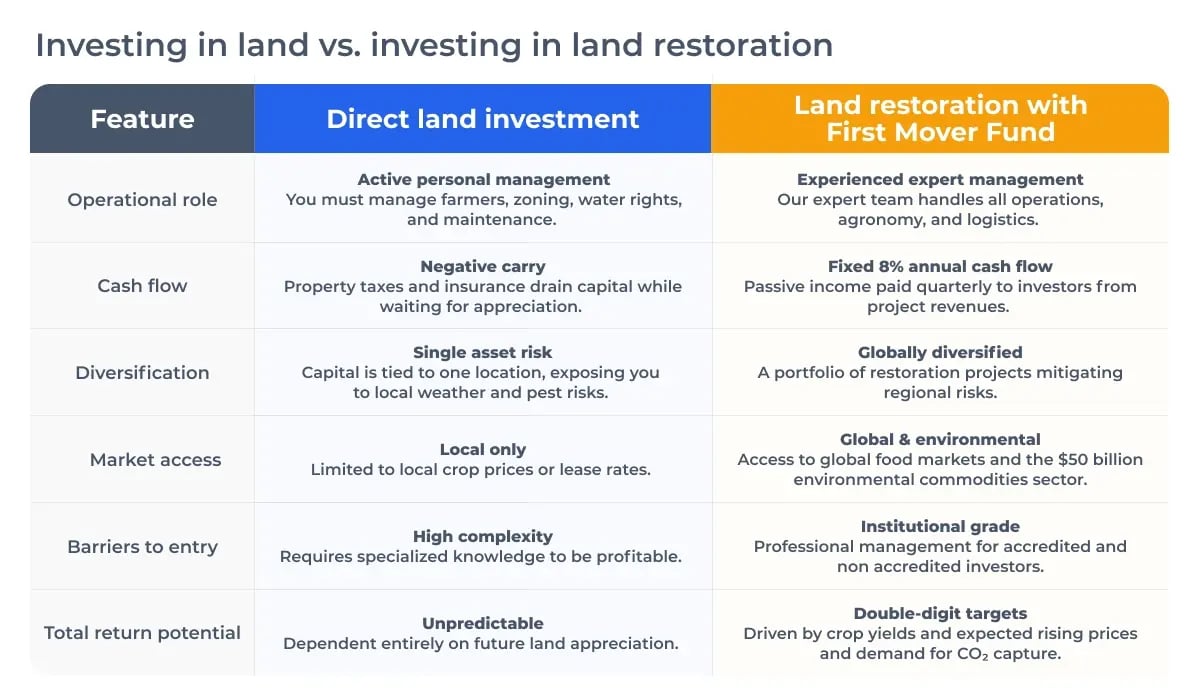 Is investing in land a good idea? In this chart you can find how investing in land compares with investing in land restoration
We invite you to examine the fundamental benefits of land restoration and see why the smartest capital is moving first into productive, regenerative assets.
Book a call with our experts to explore early access.

*Disclaimer: This article is for informational and educational purposes only. It does not constitute investment advice, a recommendation to buy, sell, or hold securities, or any form of solicitation. Investing involves risks, including possible loss of principal. Always conduct your own research and consult qualified financial professionals.