
The global agricultural system is approaching a structural tipping point. For decades, the primary objective of land management was extraction, maximizing short-term yields at the expense of long-term soil integrity. Today, that model is failing. With over 25% of the world’s agricultural land now classified as degraded, the cost of ‘business as usual’ has become a literal drain on global GDP.
Is investing in land a good idea? It is, but only if you are looking at the assets of the future. The smart capital is no longer chasing depleted acreage; it is moving toward land restoration.
Land restoration is the process of reversing soil degradation and rehabilitating ecosystems to their full productive potential. It is not merely a green initiative; it is a fundamental restructuring of how we value and monetize the Earth's most finite resource. By shifting from extractive farming to regenerative systems, we aren't just saving the environment; we are building a more efficient, high-margin agricultural economy.

Land restoration techniques and methods
To understand the value of the asset, one must understand the technology of restoration. It does not rely on speculation; it relies on proven, scalable land restoration methods that turn 'worthless' dirt back into high-performance soil. To achieve that, you can trust on some of the following land restoration examples:
1. Agroforestry and silvopasture
Agroforestry is the deliberate integration of trees and shrubs into crop and livestock systems. It is the antithesis of modern monoculture.
-
Alley cropping: Planting rows of high-value trees at wide spacings with a companion crop grown in the 'alleys' between the rows. This protects the crops from wind and thermal stress while providing a secondary income stream from timber or fruit.
-
Silvopasture: The marriage of forestry and grazing. Livestock are integrated into forested areas, where trees provide shade and shelter, reducing animal stress and improving weight gain. Simultaneously, the manure fertilizes the trees, creating a closed-loop system.
Discover more: Best investment opportunities in nature
2. Conservation and regenerative agriculture
.webp?width=1200&height=700&name=090226_FMF_Why%20is%20land%20restoration%20important__visial%201%26featured%20(1).webp) Why is land restoration important? AI generated picture.
Why is land restoration important? AI generated picture.
These techniques focus on the soil as a living organism rather than a chemical substrate.
-
No-till farming: Traditional tilling (plowing) breaks up soil structure and releases stored carbon into the atmosphere. No-till methods leave the soil undisturbed, allowing the fungal and microbial networks to stay intact, which dramatically improves water retention.
-
Cover cropping: Land should never be left bare. Between main cash-crop cycles, restorative species like clover or rye are planted. These cover crops prevent erosion, suppress weeds naturally, and fix nitrogen into the ground, reducing the need for expensive synthetic fertilizers.
-
Complex crop rotation: Moving away from the corn-soy-corn cycle. By rotating a diverse array of crops, we break pest cycles and ensure the soil is not depleted of specific nutrients.
Discover more: Benefits of investing in regenerative agriculture
3. Natural and assisted regeneration
Sometimes the most efficient restoration involves stepping back and allowing the land’s own biology to do the heavy lifting.
-
Farmer managed natural regeneration (FMNR): A low-cost, high-impact method where farmers identify and protect regrowing native trees from existing root systems or stumps. This is particularly effective in arid regions to combat desertification.
-
Assisted natural regeneration (ANR): Active intervention to speed up natural recovery. This might involve removing invasive species that are choking the ecosystem or planting pioneer species that prepare the ground for more sensitive, high-value trees later.
4. Water and landscape engineering
Healthy land must be able to manage water. Degraded land often suffers from crusting, where rainwater simply runs off the surface rather than soaking in.
-
Keyline design and subsoiling: Using specialized plows to create deep, narrow channels that follow the natural contours of the land. This slows down runoff and spreads water evenly across the landscape, effectively 'drought-proofing' the asset.
-
Gully plugs and check dams: In areas with heavy erosion, we build small barriers from natural materials to slow down water flow. This allows sediment to settle and creates fertile 'pockets' where vegetation can take root again.
5. Biological soil amendments
.webp?width=1200&height=700&name=090226_FMF_Why%20is%20land%20restoration%20important__visial%201%26featured%20(2).webp) Why is land restoration important? It uses biological boosters like biochar. AI generated picture.
Why is land restoration important? It uses biological boosters like biochar. AI generated picture.
Instead of petroleum-based fertilizers, restoration relies on biological boosters.
-
Composting and vermicompost: Utilizing organic waste and earthworms to create a nutrient-dense humus that jumpstarts soil life.
-
Biochar: A specialized charcoal created from waste biomass. When added to soil, it acts like a permanent 'coral reef' for microbes, holding onto nutrients and water for centuries while sequestering carbon for the long term.
By deploying these methods in a structured, institutional framework, it’s feasible to transform degraded, low-value land into high-yielding productive acreage. So you can move beyond the buy-and-hold strategy into an improve-and-optimize model that serves both the investor and the environment.
Discover more: Driving revenue through sustainability initiatives
The growing portfolio of land restoration projects
Worldwide, land restoration projects are moving from the fringes to the mainstream. We are seeing massive transitions in regions like Sub-Saharan Africa, Latin America, and the American Midwest. These projects are no longer small-scale experiments; they are institutional-grade operations covering thousands of hectares.
.webp?width=1200&height=700&name=090226_FMF_Why%20is%20land%20restoration%20important__visial%201%26featured%20(3).webp) Why is land restoration important in Africa? It creates employment for thousands of families. AI generated picture.
Why is land restoration important in Africa? It creates employment for thousands of families. AI generated picture.
The most successful projects share a common trait: They are multi-functional. A single project might produce high-value macadamia nuts for export, provide local food security, and capture thousands of tons of CO₂ for global corporations. This diversification is the hallmark of a resilient investment.

Importance of land restoration for food and the environment
Why is land restoration important? Because the math of survival demands it.
Traditional intensive agriculture is becoming increasingly expensive. As soil loses its natural fertility, farmers are forced to buy more fertilizer and more water to achieve the same results. This yield gap is a silent killer of agricultural profits.
Restored land is simply more efficient. It requires fewer external inputs because the ecosystem itself provides the services: pollination, water filtration, and nutrient cycling, that farmers previously had to buy. Furthermore, in a world of increasing weather volatility, restored land is more resilient. It holds onto water during droughts and prevents runoff during floods, protecting the underlying capital.
Discover more: The future of sustainable investing solutions
What does land restoration do for our economy
The economic argument for land restoration is staggering. For every dollar invested in restoration, it is estimated that up to $30 in economic benefits are created. This is a reflection of how natural capital underpins the entire global economy.
When land is restored, the return isn't just a line item on a balance sheet; it is a fundamental increase in the productive capacity of the geography. Here is how that value compounds.
The reduction of hidden agricultural costs
Degraded land is an expensive liability. It requires ever-increasing amounts of synthetic fertilizers, chemical pesticides, and intensive irrigation to maintain even baseline yields. Land restoration reverses this trend by repairing the soil’s natural nutrient cycles and water-holding capacity. By restoring the biological infrastructure of the land, we significantly lower the operational overhead of farming. This shift from high-input chemical dependence to low-input biological efficiency creates a more resilient and higher-margin agricultural model.
Infrastructure protection and environmental resilience
Land restoration acts as a natural insurance policy for regional infrastructure. Degraded landscapes are prone to erosion, flash flooding, and dust storms, which cause billions of dollars in damage to roads, power grids, and downstream water treatment facilities. Restored land, particularly through agroforestry and silvopasture, stabilizes the soil and regulates water flow. This natural buffering reduces the frequency of disaster spending by governments and private entities, preserving capital and ensuring that the local economy remains operational even during extreme weather events.
Enhanced asset valuation and collateral
Restoration is a direct value-add play for real estate. In the traditional market, land is often valued purely on its current crop yield. However, the new economy is beginning to price ecosystem integrity. A restored tract of land with deep topsoil, secure water rights, and established tree cover is fundamentally more valuable than a depleted dust bowl. This increase in the underlying asset’s quality provides stronger collateral for financing and ensures long-term capital appreciation that outpaces traditional, extractive agricultural land.
The restoration economy and job creation
Land restoration is a catalyst for regional stability. Unlike industrial monocultures that require minimal seasonal labor and heavy machinery, land restoration companies create high-quality, year-round land restoration jobs. These roles range from specialized agronomists and site managers to local teams involved in planting and maintenance. This builds a circular economy where the wealth generated from the land stays within the community, creating more stable and prosperous markets for the commodities produced.
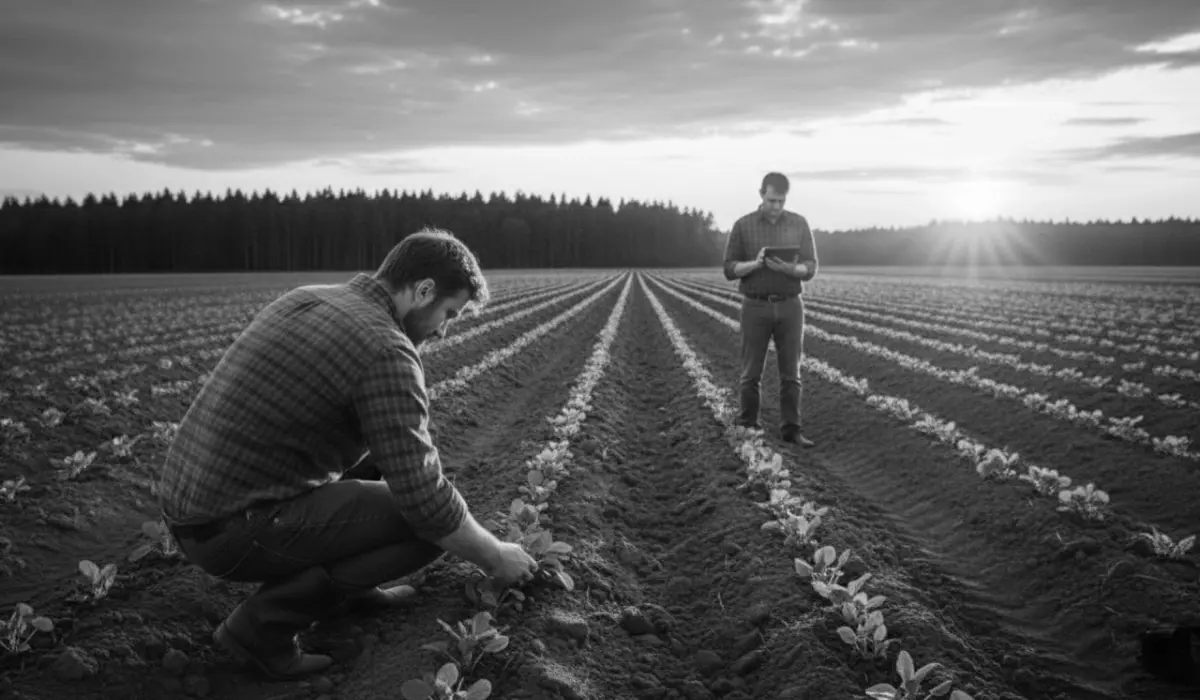
.webp?width=1200&height=700&name=090226_FMF_Why%20is%20land%20restoration%20important__visial%201%26featured%20(4).webp) Two agronomists checking the condition of their crops while reviewing data on a tablet. Why is land restoration important? AI generated picture.
Two agronomists checking the condition of their crops while reviewing data on a tablet. Why is land restoration important? AI generated picture.
The rise of environmental commodities
Perhaps the most significant economic shift is the birth of the environmental commodities market. Global corporations are looking for high-integrity, verified CO₂ capture.
Discover more: 5 Reasons why environmental commodities are the future
As mandatory climate disclosure regulations tighten in 2026, companies are willing to pay top dollar for carbon that is physically sequestered in the roots and trunks of a restored forest or the deep layers of regenerative soil. This is a new, uncorrelated revenue stream that didn't exist twenty years ago.
Will land restoration be the future?
The future of agriculture isn't just about growing more food; it's about growing food in a way that heals the asset. We call this the land-based transition.
Discover more: Top commodities to invest in today
In the next decade, we expect to see a total decoupling of land value from simple acreage. Instead, land will be valued by its integrity score: its ability to produce food, hold water, and capture CO₂ simultaneously. Investors who recognize this trend early are the first movers of the next half-century. They are buying the productive capacity of the future at today’s undervalued prices.

Investing in land restoration with the First Mover Fund
For the sophisticated investor, the question isn't whether land restoration is the future, but how to gain exposure to it without the operational burden of managing a farm.
This is where the First Mover Fund provides the institutional bridge. We don't just talk about restoration; we operate at the frontier of it.
First Mover Fund offers a disciplined, structured way to participate in this inevitable shift toward regenerative assets. The Fund offers you exclusive access and direct exposure to the rapidly expanding environmental commodities market, which is expected to reach $50 billion by 2030.
Key investment highlights:
-
Fixed 8% annual cash flow: We prioritize liquidity for our investors, with payments made quarterly.
-
Targeted double-digit returns: We capture the upside from crop yields, land appreciation, and CO₂ capture.
-
Defined 5+ years investment horizon: A disciplined lifecycle designed to optimize land restoration, value creation, and structured exit timing.
-
Strategic entry: A $200k minimum investment for qualified investors looking to move before the institutional crowd saturates the market.
History rewards those who see the value in an asset before it becomes obvious to the masses. Land restoration is currently misunderstood, undervalued, and overlooked: the perfect environment for a first mover.
Book a call with our fund manager to explore how first movers position capital in the restoration economy.