

For decades, the foundation of modern wealth management rested on a single, universally accepted mathematical premise. If you mixed a specific ratio of growth assets with defensive assets, you could achieve steady returns while protecting your capital from severe market downturns.
This premise built the modern financial advisory industry. However, over the past few years, the macroeconomic environment has shifted dramatically. The foundational rules are breaking down under the weight of sustained inflation, rising interest rates, and correlated market shocks.
Sophisticated investors are currently looking for a new balanced portfolio because the old rules struggled precisely when they were needed most. We are seeing a structural migration of capital away from traditional fixed income and toward tangible, productive real assets.

To understand why this shift is happening, we must first examine why the old model broke.
What is the 60/40 portfolio?
To understand the current crisis in traditional asset allocation, we need to ask what is the 60/40 portfolio in its purest form.
It is an investment strategy that allocates 60% of a portfolio's capital to equities (stocks) and 40% to fixed income (bonds). The logic is elegant and historically sound. Equities provide long-term capital appreciation and dividend growth during economic expansions. Bonds provide a fixed yield and act as a shock absorber during recessions, as investors typically flee to the safety of government debt when stock markets decline.
This strategy worked brilliantly for a very specific forty-year window. From the early 1980s until recent years, global interest rates were in a long-term structural decline. Falling interest rates automatically increase the value of existing bonds. Therefore, the defensive 40% of the portfolio was not just protecting capital; it was actively generating substantial capital gains.
Discover more: Top commodities to invest in today
What is the average return on a 60/40 portfolio?
Historically, wealth managers touted impressive metrics to justify this allocation. If you look at the historical data, what is the average return on a 60/40 portfolio over the last century? Over 10 years, it generally hovered around an annualized return of 8% to 9%.
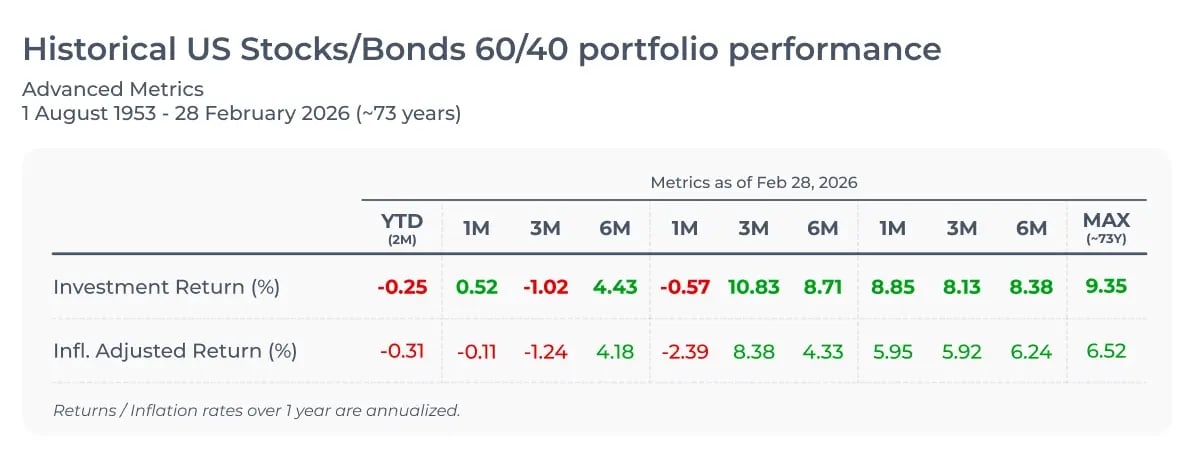 What is the average return on a 60/40 portfolio? Source: LazyportfolioETF.com
However, historical averages obscure the reality of the present moment. That impressive average return was heavily subsidized by a macro environment that no longer exists.
When inflation spiked recently, the math of the traditional balanced portfolio completely unraveled. Inflation erodes the purchasing power of fixed-income yields. Central banks responded by raising interest rates rapidly. Because bond prices fall when interest rates rise, the defensive 40% of the portfolio suffered historic losses.
Simultaneously, rising rates contracted corporate valuations, causing the 60% equity allocation to plummet. Investors realized that the average historical return means nothing when both sides of your portfolio are actively losing value in real terms.
Discover more: How can you counteract the impact of inflation?
Is the 60/40 portfolio dead?
The financial press frequently asks if the 60/40 portfolio is dead. While 'dead' might be an absolute term, the strategy is undeniably compromised for the modern macroeconomic climate.
The core issue is correlation. The entire 60/40 thesis relies on stocks and bonds moving in opposite directions during a crisis. In recent inflationary environments, their correlation turned positive. They dropped together. When the defensive portion of your portfolio fails to defend, the strategy is functionally broken.
Discover more: The most stable investment during the stock market drop
Furthermore, traditional government bonds currently offer yields that barely outpace real inflation. Investors holding these assets are experiencing 'negative carry', where their capital slowly loses its purchasing power year after year.
For the high-net-worth investor, accepting a guaranteed loss of purchasing power in exchange for the illusion of safety is no longer an acceptable strategy.
Alternatives to 60/40 portfolio strategies
To rebuild the defensive portion of a portfolio, sophisticated capital is moving toward non-correlated, real assets.
When exploring alternatives to 60/40 portfolio allocations, investors often look at real estate or traditional private equity. However, commercial real estate is currently battling oversupply and high financing costs. Traditional private equity often locks capital in a black box for a decade with no interim liquidity.
The modern balanced portfolio requires an asset class that provides the fixed income of a bond, the inflation protection of a tangible asset, and the growth potential of equity.
This is why institutional capital is pivoting toward productive agricultural land and environmental commodities. It is not an impact choice. It is a structural necessity for a resilient portfolio.

The new balanced portfolio: productive land restoration
Land is the foundation of the global economy. It is finite, historically resistant to inflation, and entirely uncorrelated to the Federal Reserve's interest rate decisions or public market sentiment.
However, simply buying raw land presents operational challenges and negative carry costs. The true alternative to the broken 40% is land restoration.
Land restoration takes undervalued, degraded soil and applies expert agronomy to return it to peak productivity. By partnering with local farmers, this model transforms a dormant asset into a multi-revenue engine.
Discover more: Why is land restoration important?
A restored landscape produces high-demand agricultural crops like cacao, coffee, and macadamia. More importantly, regenerative farming practices physically sequester carbon into the soil and biomass. This generates verified CO₂ capture credits, supplying a global corporate compliance market that analysts project will reach $50 billion by 2030.
 African landscape view of productive regenerative farmland with diverse crops. AI generated picture.
This creates a highly efficient asset. The crops and the environmental commodities provide the steady cash flow that bonds used to offer, while the underlying land appreciates in value.

First Mover Fund: your access to the new balanced portfolio
At the First Mover Fund, we provide the institutional-grade vehicle for U.S. investors to replace the underperforming aspects of their traditional portfolios. We do not speculate on public market trends. We rely on the oldest economic fundamentals: You put something in the ground, and with expert care and time, more comes out.
Now, we are unlocking this exact opportunity for the U.S. market. We partner with farmers to execute the restoration, and we structure the returns to meet the demands of sophisticated capital.
Key investment highlights:
-
Fixed 8% annual cash flow: Paid quarterly, replacing the yield lost from traditional fixed-income markets.
-
Targeted double-digit total returns: Capturing the upside of agricultural yields, land appreciation, and the rapidly expanding environmental commodities market.
-
Disciplined structure: A $200K minimum investment with a clear 5 to 7 year horizon.
-
Uncorrelated stability: Real assets completely detached from stock market volatility.
The traditional 60/40 portfolio relied on a macroeconomic environment that has passed. The new balanced portfolio relies on the physical reality of our planet and the inevitable demand for food and environmental integrity.
History consistently rewards those who secure foundational assets before the broader market recognizes their value.
Book a call with our Fund Manager to learn how first movers are restructuring their portfolios with productive land.

*Disclaimer: This article is for informational and educational purposes only. It does not constitute investment advice, a recommendation to buy, sell, or hold securities, or any form of solicitation. Investing involves risks, including possible loss of principal. Always conduct your own research and consult qualified financial professionals.