

The current macroeconomic landscape presents a significant challenge for the sophisticated investor. Traditional equity markets are, by many historical metrics, trading at historic premiums. With the S&P 500 trading at elevated multiples in recent years, valuations assume flawless corporate execution and perfectly accommodating monetary policy. When assets are priced to perfection, the margin of safety disappears.
If corporate earnings miss estimates by even a fraction, or if inflation proves stickier than central banks project, these valuations can contract violently. In this environment, investors face a symmetric, or even negatively skewed, risk profile. You are risking a substantial loss of capital for a relatively modest potential gain.
To build true generational wealth, capital must be allocated differently. Institutional investors do not simply accept the risk parameters offered by public markets. Instead, they seek out overlooked asset classes where the fundamental rules of risk and reward are skewed heavily in their favor.

This requires a disciplined understanding of how to structure capital to capture asymmetric upside while rigorously protecting the principal.
What is asymmetric upside?
In traditional finance, we are taught that risk and reward are directly correlated. To achieve higher returns, you must accept a higher probability of losing your capital. While this is true in efficient, highly liquid public markets, it is not a universal law of economics.
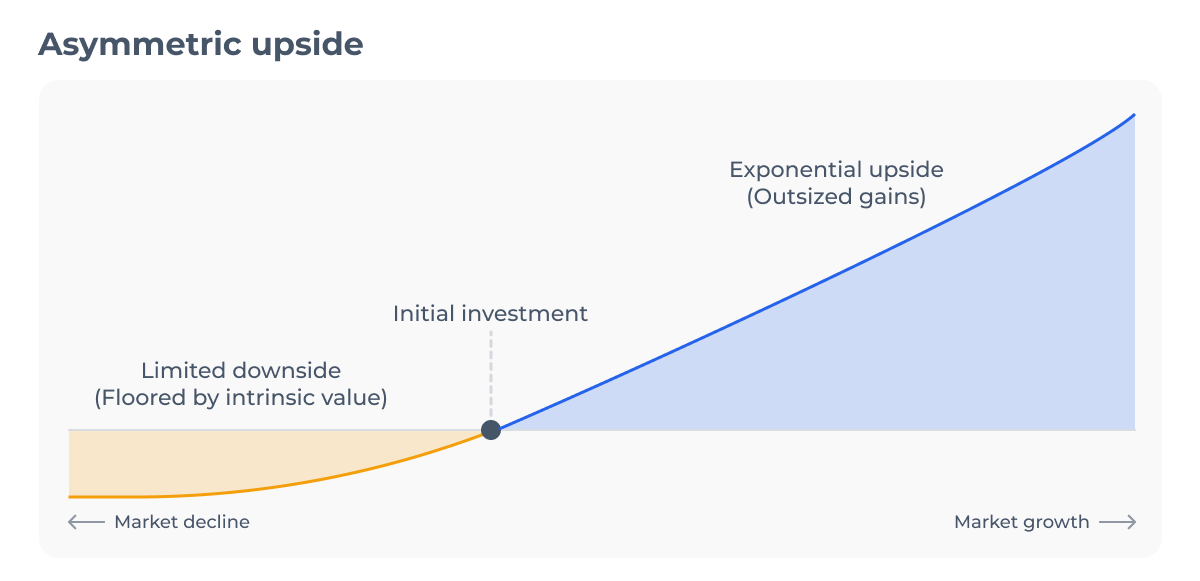 Asymmetric upside explanation chart: limited loss & unlimited potential.
So, what is asymmetric upside? In its simplest terms, it is an investment scenario where the potential for financial gain is significantly higher than the potential for financial loss.
Discover more: The most stable investment during the stock market drop
To fully grasp the asymmetric upside meaning, consider the mathematical relationship of the trade. If you invest capital where your maximum downside is strictly floored by the intrinsic value of a physical asset, but your upside is tied to an exponential growth market, the equation is asymmetric. You might risk a temporary lack of liquidity, but you are not risking a permanent destruction of capital.
The goal of sophisticated wealth management is to fill a portfolio with these skewed opportunities, capturing outsized gains when the thesis proves correct, while relying on the underlying asset to prevent catastrophic losses if macroeconomic conditions deteriorate.
Discover more: How to evaluate investment opportunities
The reality of asymmetric upside risk
It is a common misconception that investments with massive upside are inherently dangerous. This misunderstanding stems from confusing volatility with risk.
In speculative markets, such as early-stage tech venture capital, the asymmetric upside risk is binary. The company either becomes a unicorn, delivering a 100x return, or it goes bankrupt, resulting in a total loss of the initial investment. While the upside is asymmetric, the downside is total.
Institutional real asset investing approaches this differently. We seek opportunities where the downside is not a total loss, but rather a stable, albeit unexciting, preservation of capital. If the exponential growth thesis takes longer to materialize than expected, the investor is not wiped out. They are simply holding a valuable, productive asset that continues to yield baseline returns.
This is the essence of limited downside risk. It is achieved by anchoring the investment to something the world absolutely needs, rather than something the world might eventually want.
Discover more: Why the traditional 60/40 balanced portfolio is failing today's investor
Searching for the safest structured options with limited downside
When high-net-worth individuals look to protect their portfolios from inflation and market corrections, they traditionally turn to fixed-income vehicles like government bonds or commercial real estate. However, bonds currently struggle to provide yields that meaningfully outpace real inflation, resulting in a slow erosion of purchasing power. Commercial real estate is battling high financing costs and structural shifts in how office spaces are utilized.
Discover more: Real estate vs. nature investment: why nature holds the edge
This leaves a vacuum. Where do investors look when searching for the safest structured options with limited downside?
The answer lies in returning to the bedrock of the global economy. Wealth eventually seeks the foundation of all real economic output, which is productive land. However, simply buying raw acreage is an inefficient use of capital. Raw land carries maintenance costs, property taxes, and operational burdens that create negative cash flow.
The true asymmetric opportunity lies in the active restoration of undervalued land.

How land provides limited downside
Land restoration begins with a fundamental truth. They are not making any more land, but the global population continues to demand more from it.
 A farmer working on restored land. AI generated picture.
When you acquire degraded, undervalued land, you are buying an asset at a steep discount. By applying expert agronomic practices to restore soil health and water retention, you fundamentally increase the intrinsic value of that geography.
Discover more: Top commodities to invest in today
Unlike a software company that can be rendered obsolete by a new algorithm, productive agricultural land will never lose its core utility. It produces food and essential commodities. This physical reality creates a hard floor under the investment, providing true limited downside.
If the broader financial markets crash, the world still requires agricultural output. The intrinsic value of fertile soil and secure water rights remains intact, shielding the investor from the emotional volatility that plagues public equities.
Discover more: How investors can navigate a volatile stock market
The catalyst for asymmetric upside growth
If the land itself provides the safety net, where does the exponential return come from? It comes from the dual-revenue nature of modern land restoration.
When degraded land is restored through regenerative agriculture and agroforestry, it becomes highly productive. We partner with local farmers to cultivate high-demand global crops like cacao, coffee, and macadamia. This agricultural output provides a stable, baseline cash flow.
However, the "pop" that creates asymmetric upside growth comes from the environmental byproduct of this restoration. Regenerative farming practices physically sequester carbon into the soil and the biomass of the newly planted trees. This biological process generates verified CO₂ capture units.
Discover more: 5 Reasons why environmental commodities are the future
We are currently witnessing a historic shift in global commerce. Mandatory climate disclosure regulations and net-zero corporate commitments are forcing the world's largest companies to purchase these verified environmental commodities. This demand is not driven by consumer sentiment; it is driven by strict compliance obligations.
The growth projections for this sector are staggering. Analysts at Morgan Stanley expect the global market for voluntary environmental commodities to multiply from roughly $2 billion in 2022 to nearly $100 billion by 2030. Furthermore, data from EY projects that prices in the high-integrity environmental market could rise 6x by 2031.
You acquire the stability of land, which protects your downside, while gaining direct exposure to a market projected to grow by a factor of six. This is the definition of a highly favorable, asymmetric investment.

The 'farmer first' execution model
Recognizing the macroeconomic theory is only the first step. Execution is what determines the actual return.
Many impact funds fail because they treat land restoration as an academic exercise or a charity initiative. They focus on the environmental narrative rather than the operational reality.
At First Mover Fund, we operate on a strictly pragmatic, 'farmer first' philosophy. We know that the only way to generate consistent returns and high-quality CO₂ capture units is through rigorous, expert land management. We partner directly with experienced farmers on the ground. They are the asset managers of the soil.
 Two farmers working on their farmland in Africa. AI generated picture.
By empowering farmers with the capital and regenerative techniques necessary to revitalize exhausted land, we turn a theoretical thesis into measurable, physical output. When the farmers thrive and the land produces again, the financial logic clicks immediately for our investors. The environmental impact is simply the byproduct of superior agricultural performance.
Discover more: Benefits of investing in regenerative agriculture
The First Mover Fund advantage
For U.S. investors seeking to escape overvalued public markets, the First Mover Fund offers an institutional-grade vehicle to capture this specific asymmetric opportunity.
We do not speculate on trends; we rely on proven execution. Our mother company, Green Earth, has operated in the global land restoration sector for years. The financial team driving the First Mover Fund brings a formidable track record. For 22 consecutive quarters, our European investors have received their targeted returns on time, driven by the success of our highly productive nature projects.
 Green Earth’s projects. Source: Green Earth
Now, we are unlocking this exact strategic advantage for the United States market.
We structure our fund to deliver both stability and growth, perfectly aligning with the principles of an asymmetric portfolio strategy.
Key investment highlights of the First Mover Fund:
-
Fixed 8% annual cash flow: Paid quarterly from the reliable sale of agricultural crops and operational revenues, providing the liquidity and stability investors require.
-
Targeted double-digit total returns: Capturing the long-term upside of land appreciation and the predicted 6x growth market of verified CO₂ capture units.
-
Proven execution: Built on the operational success and 22-quarter track record of our mother company, Green Earth.
-
Real, tangible assets: Your capital is backed by physical land and measurable agricultural productivity, entirely detached from stock market volatility.
-
Disciplined market entry: A $200K minimum investment with a clear 5 to 7 year horizon.

Position your capital ahead of the market
Average market returns belong to those who wait for an opportunity to become obvious. Generational wealth belongs to those who understand the fundamentals of an asset class before the institutional crowd arrives.
Right now, the combination of undervalued degraded land and the rapidly scaling environmental commodities market offers a rare window of opportunity. It allows sophisticated capital to secure a hard asset with limited downside risk, while positioning for exponential growth driven by global corporate compliance.
Do not settle for investments priced to perfection. Restructure your portfolio with the physical reality of productive land.
Book a free call with our Fund Manager today to discover how the First Mover Fund can bring asymmetric growth to your portfolio.

*Disclaimer: This article is for informational and educational purposes only. It does not constitute investment advice, a recommendation to buy, sell, or hold securities, or any form of solicitation. Investing involves risks, including possible loss of principal. Always conduct your own research and consult qualified financial professionals.